

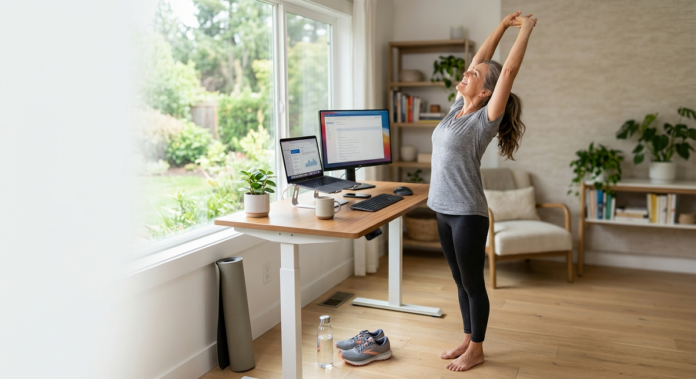
If you spend most of your day sitting at a desk, working from home, driving, or looking at a screen, you are not alone. Modern life often means sitting for hours at a time.
The problem is not simply sitting for a few minutes. It is spending most of the day with very little movement.
Long periods of sitting can leave your hips tight, your back stiff, and your neck and shoulders tense. Over time, too much sedentary time is also linked with a higher risk of several health problems.
The good news is that you do not need to spend hours at the gym to become more active.
Small amounts of movement throughout your day can make a difference. Walking, stretching, bodyweight exercises, and short movement breaks can all help you sit less and move more.
If you want more ways to get your heart rate up without going to the gym, check out our guide to Easy Cardio Workouts You Can Do at Home for simple exercises you can fit into your daily routine.
In this guide, we will look at the best exercises for people who sit all day, including easy exercises you can do at home, at work, or with very little equipment.
Why Sitting All Day Can Be a Problem
Sitting is a normal part of daily life. The concern comes when sitting takes up most of your waking hours and replaces physical activity.
The World Health Organization recommends limiting sedentary time and replacing some sitting time with physical activity of any intensity. It also recommends that adults get at least 150 minutes of moderate aerobic activity each week.
Too much sedentary behavior is associated with poorer health outcomes, including a higher risk of cardiovascular disease, type 2 diabetes, and some cancers.
Regular movement can also support:
- Heart health
- Muscle strength
- Joint mobility
- Healthy body weight
- Better mood
- Better sleep
- Energy levels
- Balance and coordination
- Overall quality of life
You do not need to become an athlete. The goal is simply to make movement a regular part of your day.
How Much Exercise Do You Need?
For most adults, a good target is at least 150 minutes of moderate-intensity physical activity each week, along with muscle-strengthening activities on at least two days each week.
Moderate activities can include:
- Brisk walking
- Cycling
- Dancing
- Water aerobics
- Hiking
- Fast-paced household chores
You can also break your activity into smaller sessions. You do not have to complete your entire weekly goal in one long workout.
For someone who sits all day, this is important.
A 30-minute walk is useful, but so are five-minute movement breaks throughout the day.
Think of exercise as something you add to your life rather than something you must do only at the gym.
The Best Exercises for People Who Sit All Day
The best routine for a person who sits all day should include a mix of mobility, stretching, strength, and cardio.
Here are some simple exercises to get started.
1. Walking
Walking is one of the easiest exercises for people who sit all day.
You do not need special equipment. You can walk outside, around your workplace, inside your home, or on a treadmill.
Try taking a short walk:
- Before work
- During lunch
- After meals
- During a phone call
- After finishing a task
- Before going home
A brisk walk can also count toward your weekly aerobic activity goal. The CDC notes that adults can spread their weekly activity across several days and smaller periods of time.
Make Walking Easier
Start with 5 to 10 minutes if you are not active right now.
Once that feels comfortable, slowly increase the time.
You can also make walking more enjoyable by listening to music, a podcast, or an audiobook.
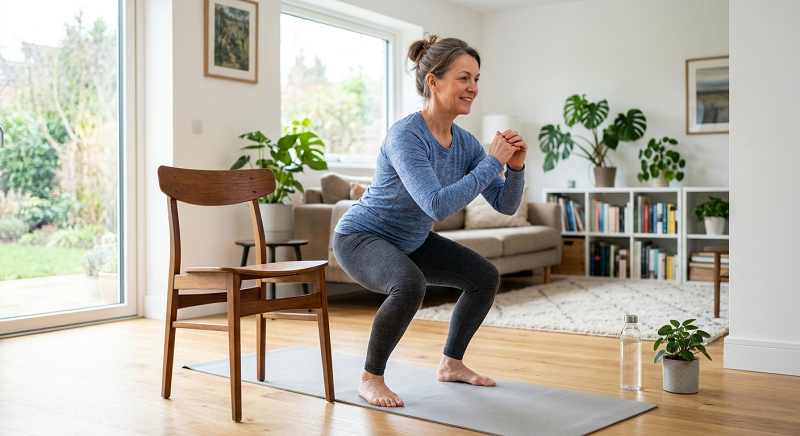
2. Bodyweight Squats
Sitting for hours means your legs may spend a lot of time inactive.
Bodyweight squats are a simple way to work your legs, hips, and core.
How to Do a Squat
- Stand with your feet about shoulder-width apart.
- Keep your chest lifted.
- Push your hips back as if you are sitting in a chair.
- Bend your knees and lower your body.
- Push through your feet to stand again.
Start with 8 to 12 repetitions.
If regular squats feel difficult, use a chair behind you for support. You can also practice sitting down and standing up from a sturdy chair.
3. Glute Bridges
Glute bridges are useful for strengthening the muscles around your hips and buttocks.
They are especially convenient because you can do them on a mat at home.
How to Do Glute Bridges
- Lie on your back with your knees bent.
- Keep your feet flat on the floor.
- Place your arms beside your body.
- Tighten your abdominal muscles.
- Press through your feet and lift your hips.
- Pause briefly at the top.
- Lower your hips slowly.
Try 8 to 12 repetitions to start.
Move slowly rather than trying to lift your hips as high as possible.
4. Wall Push-Ups
You do not need to get on the floor to work your upper body.
Wall push-ups are a beginner-friendly option.
How to Do Wall Push-Ups
- Stand facing a wall.
- Place your hands on the wall at about chest height.
- Step your feet back slightly.
- Bend your elbows and bring your chest toward the wall.
- Push yourself back to the starting position.
Try 8 to 12 repetitions.
As you become stronger, you can move to countertop push-ups and eventually regular push-ups if they feel comfortable.
5. Standing Calf Raises
Calf raises are easy to add to your workday.
They can be done while standing near a desk, wall, or sturdy chair.
How to Do Calf Raises
- Stand tall with your feet hip-width apart.
- Hold a stable surface if you need balance.
- Slowly raise your heels.
- Pause for a moment.
- Lower your heels with control.
Try 10 to 15 repetitions.
This is a simple exercise to add while waiting for your coffee, brushing your teeth, or taking a short work break.
6. Seated Hip Marches
If you cannot leave your desk often, seated exercises can help you add movement.
Sit upright in a stable chair with your feet flat on the floor.
Lift one knee toward your chest, lower it, and then lift the other knee.
Continue alternating for several repetitions.
The NHS includes seated hip marching as an exercise that can help strengthen the hips and thighs and improve flexibility.
Remember to use a stable chair that does not have wheels.
7. Chest Stretch
Hours at a computer can leave your shoulders rounded forward.
A simple chest stretch can help improve mobility and may feel good after a long period at a desk.
Sit or stand tall.
Move your arms out to the sides and gently draw your shoulders back and down. Lift your chest slightly until you feel a gentle stretch.
Hold for about 5 to 10 seconds, then relax.
The NHS recommends this type of seated chest stretch as a gentle exercise that can help with posture.
Never force a stretch. It should feel gentle rather than painful.
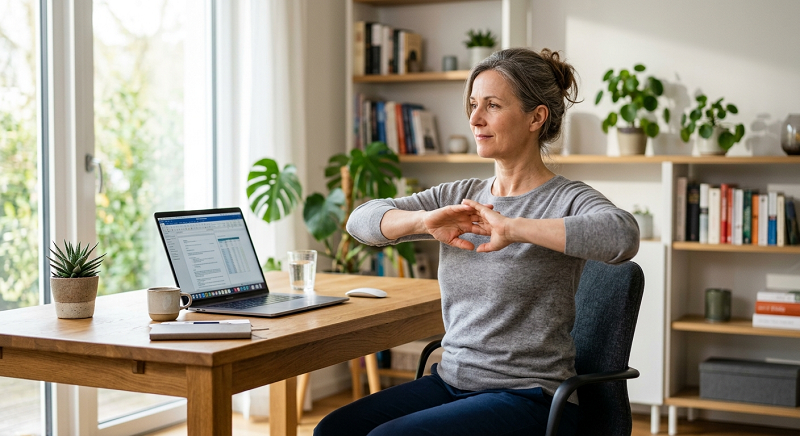
8. Upper-Body Twists
Your upper back can become stiff when you stay in one position for a long time.
A gentle upper-body twist can help maintain movement in the upper back.
Try This Seated Stretch
- Sit upright.
- Keep both feet flat on the floor.
- Cross your arms over your chest.
- Slowly rotate your upper body to one side.
- Return to the center.
- Repeat on the other side.
Move only as far as feels comfortable.
The NHS recommends gentle upper-body twists as a way to maintain flexibility in the upper back.
9. Neck Rotations
Your neck may feel tight after staring at a computer screen for hours.
Gentle neck rotations can help maintain neck mobility.
Sit upright and relax your shoulders.
Slowly turn your head toward one shoulder. Return to the center and repeat on the other side.
Do not force the movement or make fast circles with your neck.
The NHS recommends slow neck rotations for maintaining neck mobility and flexibility.
10. Bird Dogs
Bird dogs are a useful bodyweight exercise for your core and back.
Start on your hands and knees.
Slowly extend one arm and the opposite leg. Hold briefly, then return to the starting position. Repeat on the other side.
Focus on keeping your body stable.
Start with 5 repetitions per side.
If this exercise feels difficult, move only one arm or one leg at a time.
11. Step-Ups
If you have access to a safe, sturdy step, step-ups can provide a simple cardio and leg workout.
Step onto the platform with one foot, bring the other foot up, and then step down carefully.
Alternate your leading leg.
Start slowly and use a handrail if needed.
Avoid unstable chairs or furniture. Safety should always come first.
12. Planks
Planks can strengthen your abdominal and core muscles without equipment.
Start with a short hold rather than trying to stay in the position for a long time.
You can begin with a wall plank or a plank from your knees.
As you get stronger, you can progress to a full plank.
The goal is good form, not a record time.
Simple Stretches for Desk Workers
Strength exercises are important, but flexibility and mobility matter too.
If you sit for long periods, consider adding a few gentle stretches during the day.
Try:
- Chest stretches
- Upper-back rotations
- Neck rotations
- Hip stretches
- Hamstring stretches
- Calf stretches
- Ankle movements
You do not need to hold every stretch for a long time.
A few gentle movements can be enough to remind your body that it is time to move.
If a stretch causes sharp pain, stop.
The Best Movement Breaks for Office Workers
One of the easiest ways to fight long periods of sitting is to create movement breaks.
You can set a timer or use a reminder on your phone or computer.
Every so often:
- Stand up.
- Walk around the room.
- Stretch your legs.
- Roll your shoulders gently.
- Get some water.
- Take a few deep breaths.
- Return to work.
You can also use everyday tasks to increase movement.
For example:
- Walk while talking on the phone.
- Take the stairs when practical.
- Park farther away.
- Walk to speak with a coworker.
- Stand while reading a short message.
- Take a short walk after lunch.
- Do a few squats during a break.
The CDC also encourages people to break up sedentary time with active breaks and simple movements.

A Simple 10-Minute Exercise Routine for People Who Sit All Day
If you are short on time, try this simple routine.
Minute 1: March in Place
March gently to warm up your body.
Minutes 2–3: Squats
Perform 8 to 12 controlled squats.
Minutes 4–5: Wall Push-Ups
Perform 8 to 12 wall push-ups.
Minutes 6–7: Glute Bridges
Perform 8 to 12 glute bridges.
Minute 8: Calf Raises
Perform 10 to 15 calf raises.
Minute 9: Upper-Body Twists
Perform several gentle rotations on each side.
Minute 10: Easy Walking
Walk around your home or office.
This routine does not replace a complete exercise program, but it is a great way to start moving.
How to Build an Exercise Routine That Lasts
The biggest mistake people make is trying to change everything at once.
You do not need to exercise for an hour every day.
Start with something you can repeat.
For example:
Week 1: Take a 5-minute walk once or twice each day.
Week 2: Add two short strength sessions.
Week 3: Increase your walking time.
Week 4: Add more movement breaks during work.
Small habits can become part of your normal routine.
The CDC notes that some physical activity is better than none and that weekly activity can be broken into smaller periods.
A Sample Weekly Exercise Plan
Here is one simple way to organize your week:
| Day | Activity |
|---|---|
| Monday | 20–30 minute brisk walk + stretching |
| Tuesday | 10–20 minute strength routine |
| Wednesday | Walking + short movement breaks |
| Thursday | 10–20 minute strength routine |
| Friday | 20–30 minute brisk walk |
| Saturday | Longer walk, cycling, dancing, or another activity |
| Sunday | Gentle stretching and easy movement |
You can change this plan based on your schedule and fitness level.
The goal is consistency, not perfection.
Tips to Sit Less During a Busy Workday
Exercise is important, but your daily movement habits matter too.
Try making small changes to your environment.
Keep Water Nearby
Getting up to refill your water bottle creates another reason to move.
Use Walking Meetings
If your meeting does not require a computer, consider taking the call while walking.
Move During Breaks
Do not spend every break sitting in another chair while looking at your phone.
Stand up and move instead.
Make Movement Convenient
Keep comfortable shoes nearby.
Place resistance bands where you can see them.
Use reminders on your phone.
The easier movement is to start, the more likely you are to do it.
Is Exercise Enough If You Sit All Day?
Exercise is extremely helpful, but it should not be viewed as a way to completely cancel out hours of sitting.
The WHO recommends both increasing physical activity and reducing sedentary behavior.
Think about your entire day.
You can have a 30-minute workout and still spend many hours sitting.
That is why a better goal is:
Exercise regularly + move throughout the day + sit less when possible.
This approach is more practical for people who work at desks or spend much of their day sitting.
When Should You Talk to a Health Professional?
Most gentle exercises are suitable for many healthy adults, but not every exercise is right for everyone.
If you have an injury, chronic health condition, balance problems, severe pain, or have not exercised for a long time, consider speaking with a qualified health professional before starting a new exercise routine.
Stop exercising if you experience severe pain, dizziness, fainting, chest pain, or unusual shortness of breath.
Start slowly and increase your activity as your body becomes more comfortable.
Final Thoughts: Start Moving More Today
If you sit all day, you do not need to completely change your lifestyle overnight.
Start small.
Take a short walk. Stand up during your next break. Try a few squats. Stretch your chest and upper back. Walk while talking on the phone.
Then do it again tomorrow.
The best exercises for people who sit all day are not necessarily complicated exercises. They are movements you can do safely and consistently.
Walking, squats, glute bridges, wall push-ups, calf raises, stretches, and short movement breaks can all become part of a healthier daily routine.
According to the WHO, every amount of physical activity counts, and replacing sedentary time with movement can provide health benefits.
So do not wait for the perfect workout or a free hour in your schedule.
Start with five minutes today.
Your future self will thank you.
What is your biggest challenge with staying active during the day—lack of time, a desk job, low energy, or simply forgetting to move? Share your experience in the comments and tell us which exercise you plan to try first.